
Every living thing is made up of a cell. Two types of these cells are eukaryotic cells and prokaryotic cells. In science class, we learned that prokaryotic cells are different from eukaryotic cells because they don’t have nuclei and membrane-bound organelles like the eukaryotic cells. Plant cells and animal cells are types of eukaryotic cells and also have a few differences between each other. These cells have all of the same organelles except for three specific ones. Both the plant cells and animal cells have cell membranes, nuclei, ribosomes, mitochondria, endoplasmic reticula, Golgi complexes and lysosomes. It is the organelles in the plant cells that make the difference. A plant cell has a cell wall, chloroplasts and a large vacuole. It is amazing
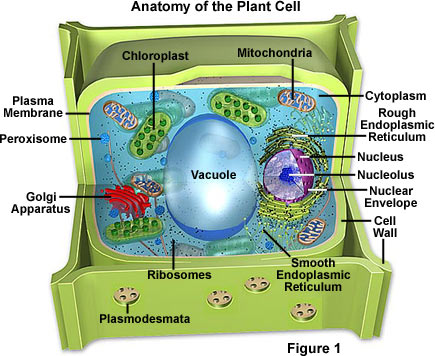 how all of these organelles can fit inside a microscopic cell and work together to make bodies like ours function. First of all, a cell membrane is a covering around all cells. This keeps the cytoplasm, or fluid in between the organelles of a cell, inside the cell and selectively allows nutrients in the cell and waste products out. I learned from a website on the Internet that cell walls are only on plant cells and make a rigid surface on the cell, giving it a shape, strength and support. I was surprised to know that this cell wall is the reason why plant cells can’t move, develop nervous systems or immune systems. No wonder! That is why plant cells are called living things but do not move around. Another difference in these two eukaryotic cells is chloroplasts. Chloroplasts are energy-converting organelles like mitochondria that make food for plant cells by using energy from sunlight. There are two membranes and many structures in chloroplasts that look like stacks of coins. They are sacs that contain chlorophyll which makes chloroplasts green and produce sugar from photosynthesis. This sugar is used by the mitochondria in the plant cell to make ATP, a molecule into which energy is transferred. From the website, I learned that these chloroplasts have a very similar structure to mitochondria but are larger than them because its inner membrane is not folded like it is in mitochondria. I wonder how such tiny organelles can produce so much energy for our cells to work. Well, the last difference between the two cells is the vacuoles. Both animal and plant cells have vacuoles but their sizes are different. A vacuole is an organelle in the cytoplasm that stores water and other materials for the cell. A plant cell needs an extra large vacuole since it needs a lot of water to live. Plants would wilt if their vacuoles were not full with water. That is why we must always fill them up by watering them to keep the plant from dying. Furthermore, I had always wondered how plants and flowers get their colorful petals and leaves. My question was answered when we learned in school that vacuoles hold the colorful liquid for the plants and flowers. Overall, plant cells and animal cells have many similarities, but it is their differences that make them unique.

2 comments:
This article really took me back to my school days. I remember those days where we did photosynthesis experiment.
- Sunshine's Mom
Wonder how the world would be, if the plant cells did not have the cell wall that made them immobile and animal cells too could make food from sunlight.
- Sunshine's Dad
Post a Comment